Yes, you can live a full and healthy life without the prostate gland. Originally, the prostate was important for fertility, but its removal will not shorten your lifespan or, more importantly, health span. Accurate diagnosis is important, and differentiating between Prostate Cancer, Benign Prostatic Hyperplasia (BPH), pelvic floor dysfunction, or another issue is crucial for appropriate treatment planning. However, for issues that require it, many men find an overall positive effect and reduced stress after a radical prostatectomy despite challenges including changes to urinary and sexual function. Adequate support from a men’s health coach or pelvic floor physical therapist is also important to mitigate the side effects while ultimately getting life-saving results.
Is prostate removal a good option?
“Why am I getting up to pee so many times each night?”
“Will this be the year my PSA levels go up?”
“I am tired of having to push so hard to empty my bladder!”
Many men, especially over the age of 50 live with these thoughts. While there may be multiple reasons for concerns such as increased nighttime urination, difficulty emptying the bladder, or urinary frequency, an issue with the prostate is certainly among the list. Treatment approaches should be discussed thoroughly with your provider and individualized to your concern and root cause of the problem. Many times, lifestyle coaching or assessment of your pelvic health may lead to improved symptoms. However, in some cases such as prostate cancer, a radical prostatectomy may be the treatment advised for the best results. Understandably, it can be scary to think of losing a part of your body you’ve had your whole life. While I wouldn’t want anybody to get a radical prostatectomy without reason, it can be a great option for cancer treatment and relief from severe prostate enlargement (BPH) and there can be positives even beyond survival.
What Is the Prostate in the First Place?
The prostate is a glandular organ specific to men. It sits below the bladder and surrounds the urethra (pee tube) that goes from the bladder and through the penis. The prostate’s job is to collect, produce, and expel the components of male ejaculate. It also houses pieces of the deep muscle system that helps pinch the urethra shut when our bladder is filling. Finally, it serves a role in converting one form of testosterone into another. None of these features are critical to living, which is why it can be removed when necessary.
The Toll of Chronic Stress
Imagine this guy (or maybe it sounds a bit like you): He is 63 years old and looking forward to his retirement just around the corner. His wife has been on him to schedule his annual check up because he has been peeing a lot more often and she has noticed. He did a quick look online and BPH came up, which didn’t sound too bad, but so did prostate cancer - and that is what his grandpa died of.
S.T.R.E.S.S.F.U.L. Stressful enough that many men will just keep “forgetting” to make that appointment, because, ya know, if we don’t go in they can’t find anything bad - right?! But not getting checked will not eliminate the stress. Now this guy will be living days, weeks, months, years (cringe) with at least a low-grade stress about what is actually going on let alone the annoying symptoms he is currently dealing with.
We’ve all heard it by now: stress is not good for our health. Elevated levels of the primary stress hormone, cortisol, can impair sleep, cause weight gain, promote heart and vessel disease, make us more irritable, and all around it just plain sucks!
Man Up, Get Checked: Prostate Screening is Easy
Getting checked or screened is just a few questions from your primary care provider and a simple blood test. Maybe it is “just” benign prostatic hyperplasia (BPH, aka: enlarged prostate)! Not life threatening, multiple treatment approaches and, once corrected, you’ll be able to make it through the 7th inning and sleep through the night without so many bathroom breaks. No more (of that) stress.
Maybe it is “just” some bad bladder habits or an issue with your pelvic floor muscles! Also, not life threatening and very treatable with pelvic floor physical therapy or men’s health coaching. Once you’ve learned bladder techniques, improved bowel health/function, optimized your pelvic floor muscle function, and learned to hydrate appropriately you won’t be missing game highlights or waking up every 45 minutes through the night. No more (of that) stress.
But, maybe, it is the scarier option: prostate cancer. The big “C” word that no one wants to hear. Without a doubt this can be a real life-changing punch in the gut, but there has never been a better time to become a survivor of prostate cancer and the earlier it is detected and treated, the easier the recovery.
BPH vs Prostate Cancer
Here is a snapshot of the differences between two common prostate issues, Benign Prostatic Hyperplasia (BPH) and Prostate Cancer. Keep in mind that many symptoms could be generated from something completely unrelated to the prostate too, such as the pelvic floor muscles.
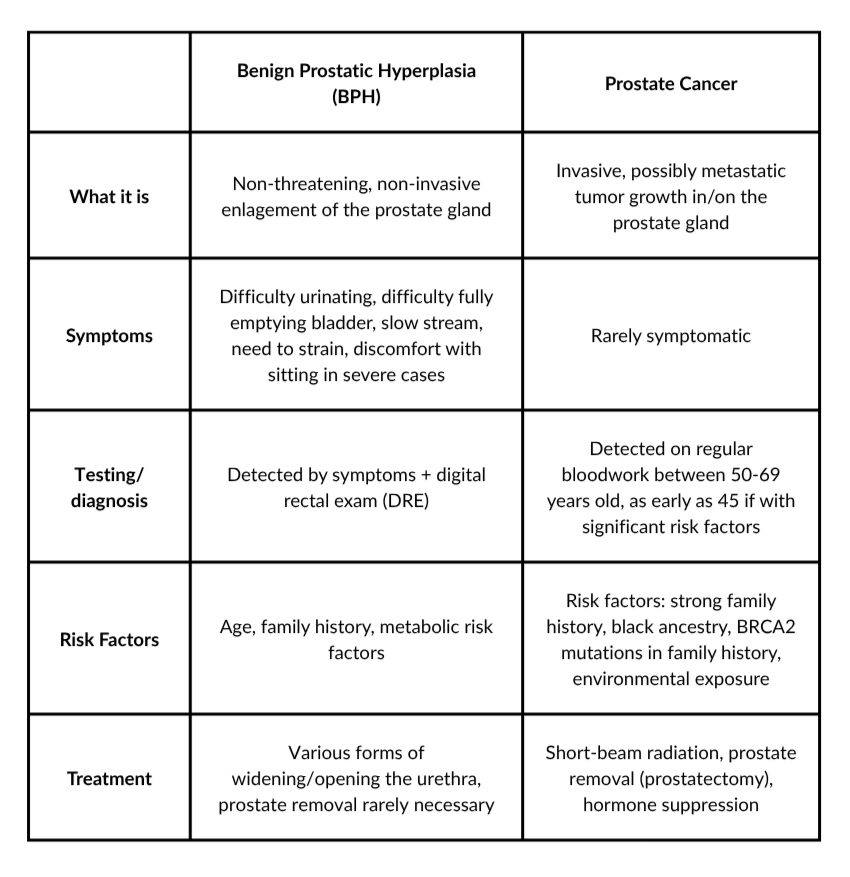
Quality of Life After Prostate Surgery
If you ever talk to people that are survivors of cancer or other serious medical conditions you will often hear two common things. A) “That sucked,” and B) “It was a real wake up call.”
A wake up call to what? Usually, taking care of their health, spending time with the people they know, love, and trust, and making time for the other things that bring them joy in life. The World Health Organization and American Cancer Society both conclude that at least 40% of all cancer occurrences can be attributed to modifiable health, lifestyle, diet, and environmental factors. Meaning, we can change things that will significantly reduce the risk of having cancer or recurrence of cancer.
Additionally, most cancer specialists will agree that the healthier a person can be going into treatment the easier their path is likely to be. So, while a cancer diagnosis, even a highly survivable one like prostate cancer, is never a good thing - it can result in good action in regards to taking care of ourselves.
Getting Support Before, During, or After A Pelvic or Prostate Concern
Can you live without a prostate? Absolutely, yes. Getting to the point of needing a prostate removal surgery is not what anyone wants or expected for their life, but with perspective and planning it can turn out to be a positive milemarker in one’s life. So, if you are experiencing any urinary difficulties or changes, having any pelvic pain, or are (at minimum) over 50, go see your doctor and ask for a comprehensive workup to rule out any scary issues. Then, no matter the result, get help - from a pelvic health coach or therapist skilled in men’s specific pelvic care.
Dr. Nathan Gilpin is a men’s health expert dedicated to helping men navigate pelvic health issues and effects of treatment. Get the answer you are looking for and a personalized game plan so you can stop your endless scrolling and get the best, most direct advice.